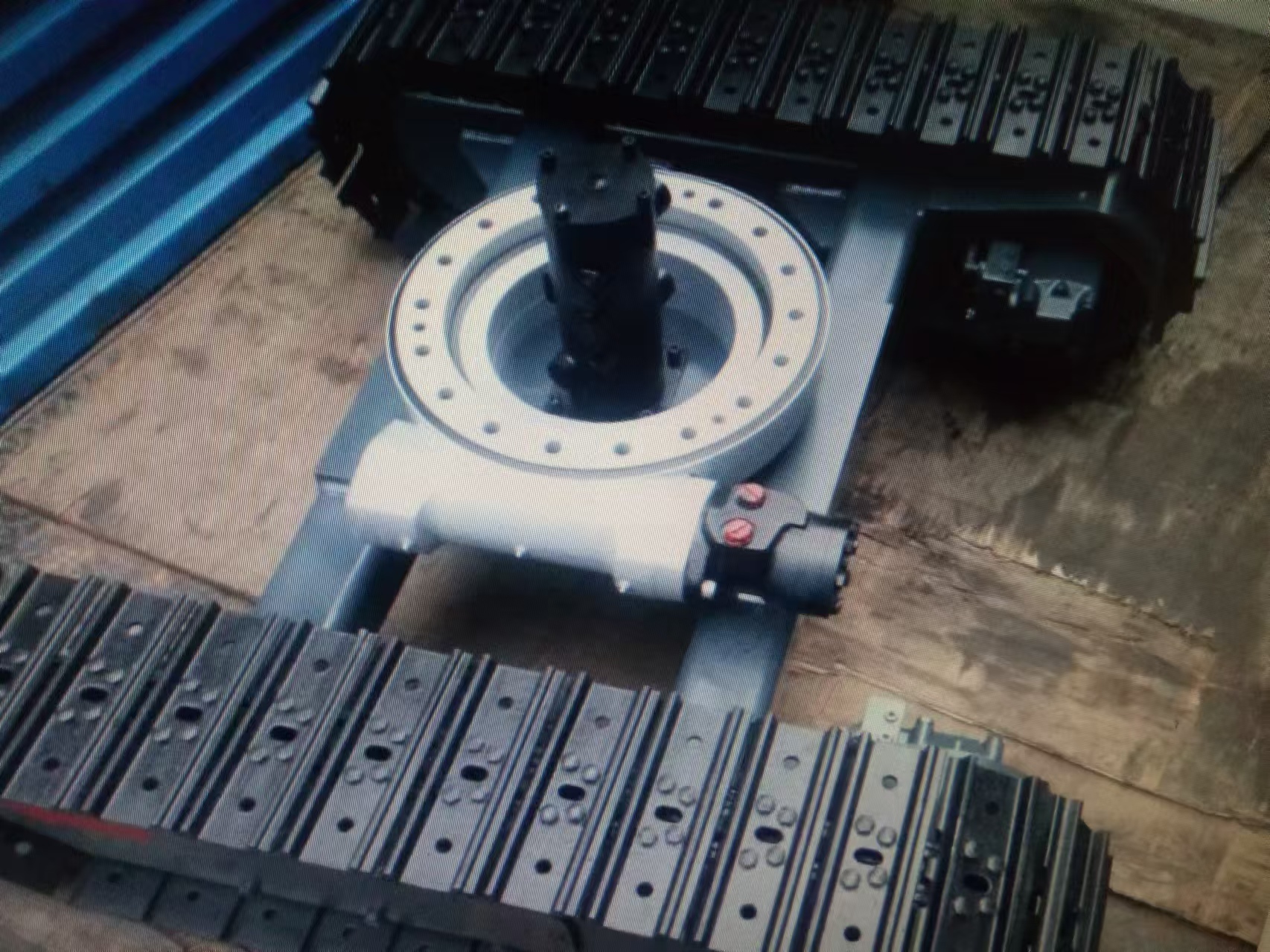
In modern engineering construction, excavators are core equipment, and their mobility and operating efficiency directly affect the progress of the project. Traditional fixed chassis excavators often face problems such as limited movement, inconvenient steering, and narrow operating range under complex working conditions. The chassis system equipped with a rotating device greatly improves the flexibility and versatility of the excavator by realizing the relative rotation of the superstructure and the chassis. This article will deeply analyze the application advantages, technical principles and typical scenarios of the rotating chassis in excavators.
1. The core technical principle of the rotating chassis
The core of the rotating chassis system lies in the coordinated design of the slewing bearing and the hydraulic drive:
Slewing bearing structure
Adopting cross roller bearings or three-row roller bearings, the load-bearing capacity can reach 20~100 tons.
The sealing design prevents the intrusion of mud and water and prolongs the service life (such as IP67 protection level).
Hydraulic drive system
Driven by hydraulic motor + reducer, it can achieve 360° unlimited continuous rotation.
Optional servo control, rotation accuracy of ±0.1° (suitable for precise operation scenarios).
Power and signal transmission
The central swivel joint (Hydraulic Swivel) ensures that the hydraulic oil circuit and the circuit are continuously connected during rotation.
2. Advantages of rotating chassis compared with traditional chassis
| Comparison items | Fixed chassis | Rotating chassis |
| Operation range | Depends on vehicle steering, limited range | The upper structure rotates independently, covering 360° without blind spots |
| Terrain adaptability | Slope operation is prone to instability | Maintain the best working angle of the bucket through chassis leveling |
| Efficiency | Frequent movement of the vehicle body, time-consuming and fuel-consuming | Quick rotation positioning, cycle time shortened by 15%~30% |
| Safety | Narrow space is prone to collision | Rotate on the spot to avoid obstacles and reduce the risk of equipment damage |
3. Typical application scenarios and cases
1. Municipal engineering (narrow space operation)
Demand: Urban pipeline laying requires multi-angle excavation in the lane.
Solution: The rotating chassis allows the cab and the digging arm to rotate in the opposite direction, and the lateral excavation can be completed without moving the vehicle body.
Case: After a municipal company adopted a rotary chassis excavator, the efficiency of underground pipe network construction increased by 40%.
2. Mine slope operation
Requirement: Stable operation on the inclined mine surface to avoid equipment slippage.
Solution: Automatic leveling of the chassis + upper rotation to ensure that the bucket is always vertical to the slope.
Case: In the slope mining of the Chilean copper mine, the accident rate of the rotary chassis excavator was reduced by 60%.
3. Emergency rescue
Requirement: Quick and multi-directional cleaning of collapsed ruins.
Solution: 360° rotation with multi-tool quick-change device (such as hydraulic shears, breaker hammers).
4. Technology development trend
Electric drive: Use electric rotary motor to reduce the risk of hydraulic leakage and reduce energy consumption by 25%.
Intelligence:
Real-time monitoring of chassis inclination angle through IMU sensors, automatically limiting the rotation speed to prevent tipping.
5G remote control + VR perspective to achieve unmanned operation of rotary chassis excavators.
Lightweight design: Carbon fiber composite slewing platform, reducing weight by 30% while maintaining strength.
5. Selection and maintenance recommendations
Selection points
Double-row roller bearing structure is preferred, suitable for heavy-load impact conditions.
Mining environment requires enhanced seal + automatic lubrication system.
Maintenance key
Check the wear of the slewing bearing gear every 500 hours.
Use high-temperature grease (applicable to -30℃~150℃) and oil regularly.